Research Topics
My research develops mathematical foundations for learning, inference, and sequential decision making. I use ideas from information theory, probability, statistics, and optimization to understand the fundamental limits of modern machine learning systems and to design algorithms that approach these limits.
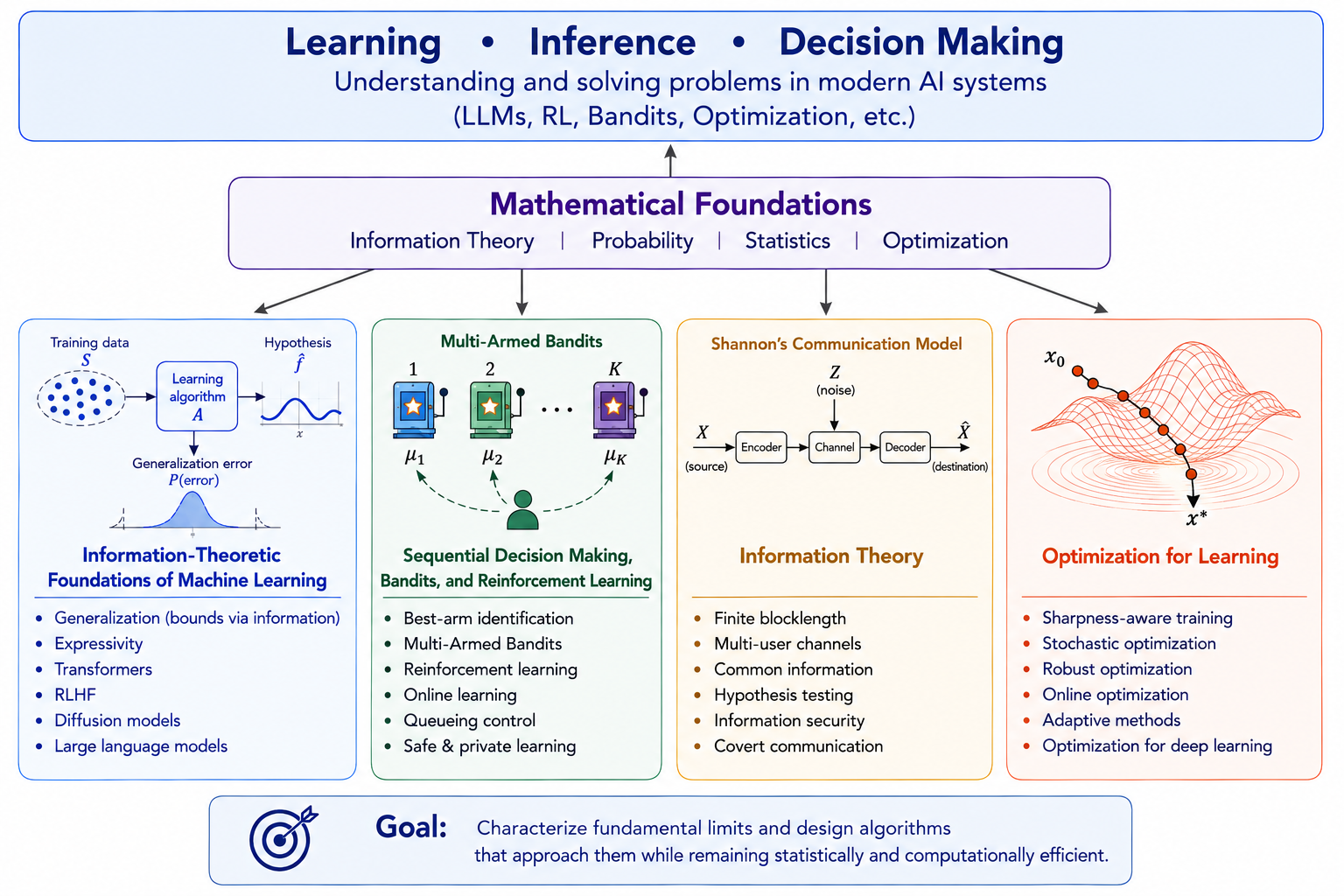
The figure above summarizes the main themes of my research and the mathematical ideas that connect them. Although organized into four broad areas, these directions are closely intertwined and frequently inform one another.
Research Areas
- Information-Theoretic Foundations of Machine Learning
- Sequential Decision Making, Bandits, and Reinforcement Learning
- Information Theory
- Optimization for Learning
- Selected Earlier Research Directions
Information-Theoretic Foundations of Machine Learning
Modern machine learning systems often achieve capabilities that are not yet adequately explained by existing theory. We develop mathematical and information-theoretic tools for studying the expressivity, generalization, statistical efficiency, and fundamental limits of modern learning systems.
Current topics include large language models, transformers, reinforcement learning from human feedback, diffusion models, semi-supervised learning, and information-theoretic generalization.
Representative Papers
- How Many Different Outputs Can a Transformer Generate?
- On the Exponential Convergence for Offline RLHF with Pairwise Comparisons
- Towards Understanding Why FixMatch Generalizes Better Than Supervised Learning
- How Does Pseudo-Labeling Affect the Generalization Error of the Semi-Supervised Gibbs Algorithm?
- Information-Theoretic Characterization of the Generalization Error for Iterative Semi-Supervised Learning
See my computer science conference papers, and journal papers for related work.
Sequential Decision Making, Bandits, and Reinforcement Learning
I study how an agent should learn and make decisions when information arrives sequentially and actions affect future observations and rewards. The objective is to characterize fundamental performance limits and to design algorithms that attain them.
Current topics include multi-armed bandits, best-arm identification, reinforcement learning, online learning, adaptive experimentation, RLHF, queueing control, and decision making under communication, privacy, safety, or robustness constraints.
Representative Papers
- Avoiding exp(k*) Scaling for Thompson Sampling in Combinatorial Semi-Bandits: From Multiple Seeds to a Single Seed
- Finite-Time Minimax Bounds and an Optimal Lyapunov Policy in Queueing Control
- Best Arm Identification with Minimal Regret
- Optimal Clustering with Bandit Feedback
- Minimax Optimal Fixed-Budget Best Arm Identification in Linear Bandits
- A Unifying Theory of Thompson Sampling for Continuous Risk-Averse Bandits
- Thompson Sampling for Cascading Bandits
See my computer science conference papers and journal papers for related work.
Information Theory
Information theory provides a mathematical language for studying communication, uncertainty, inference, and learning. My work seeks precise characterizations of fundamental limits, particularly in finite-blocklength, asymptotic, multi-user, and sequential settings.
Topics of interest include second- and higher-order asymptotics, information-spectrum methods, common information, multi-user information theory, hypothesis testing, information-theoretic security, covert communication, and strong converse theorems.
Representative Papers and Monographs
- Common Information, Noise Stability, and Their Extensions
- Optimal Adaptive Strategies for Sequential Quantum Hypothesis Testing
- Second-Order Asymptotics of Sequential Hypothesis Testing
- Time-Division is Optimal for Covert Communication over Some Broadcast Channels
- Asymptotic Estimates in Information Theory with Non-Vanishing Error Probabilities
See my monographs, journal papers, and information theory conference papers for related work.
Optimization for Learning
Modern machine learning relies on optimization procedures that must operate in high-dimensional, stochastic, and often nonconvex environments. We study optimization algorithms with provable guarantees, with particular emphasis on robustness, adaptivity, and their interaction with statistical learning.
Topics include sharpness-aware training, online optimization, stochastic optimization, robust losses, adaptive methods, and the optimization dynamics of modern neural networks.
Representative Papers
- Dynamic Regret in Outlier-Oblivious Online Optimization Using Nonconvex Robust Losses
- Muon Outperforms Adam in Tail-End Associative Memory Learning
- Sharpness-Aware Training for Free
- Efficient Sharpness-Aware Minimization for Improved Training of Neural Networks
- On Robustness of Neural Ordinary Differential Equations
See my computer science conference papers and journal papers for related work.
Selected Earlier Research Directions
Earlier in my career, I worked extensively on statistical signal processing, graphical models, and matrix factorization. These projects continue to inform my broader interest in mathematically principled methods for extracting structure from complex data.
Statistical Signal Processing and Matrix Factorization
- Distributionally Robust and Multi-Objective Nonnegative Matrix Factorization
- Online Nonnegative Matrix Factorization with Outliers
- Automatic Relevance Determination in Nonnegative Matrix Factorization with the β-Divergence
- Estimating Signals with Finite Rate of Innovation from Noisy Samples: A Stochastic Algorithm
Graphical Models and Structure Learning
- High-Dimensional Structure Estimation of Ising Models: Local Separation Criterion
- High-Dimensional Gaussian Graphical Model Selection: Walk Summability and Local Separation Criterion
- Learning Latent Tree Graphical Models
- A Large-Deviation Analysis of the Maximum-Likelihood Learning of Markov Tree Structures
Research Philosophy
I enjoy working on problems that combine elegant mathematics with practical relevance. Much of my research begins by identifying a fundamental limitation in a learning, inference, or decision-making problem. I then seek an information-theoretic or statistical characterization of this limit and develop algorithms that approach it while remaining statistically and computationally efficient.
Current Directions and Open Problems
Some broad questions currently motivating my group include:
- How can information theory help explain the capabilities and limitations of large language models?
- Can sequential decision-making algorithms simultaneously achieve strong guarantees for identification, regret, privacy, safety, and robustness?
- How do finite-sample and second-order effects alter the classical asymptotic limits of communication, inference, and learning?
Prospective students and postdoctoral researchers interested in these questions are welcome to read about my research group and current research projects.